The White Stones by J. H. Prynne
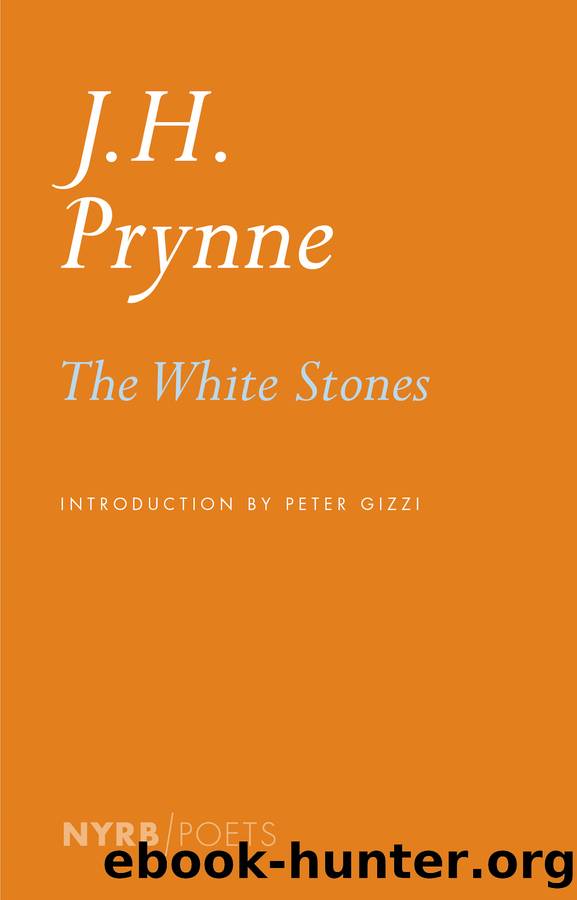
Author:J. H. Prynne [Prynne, J.H.]
Language: eng
Format: epub
ISBN: 978-1-59017-980-2
Publisher: New York Review Books
Published: 2016-03-10T00:00:00+00:00
Aristeas, in Seven Years
Gathering the heat to himself, in one thermic
hazard, he took himself out: to catch up with
the tree, the river, the forms of alien vantage
1 and hence the first way
by theft into the upper worldââa
natural development from the mixed
economy in the drier or bleaker
regions, where more movement was
necessaryââand thus the
floodloam, the deposit, borrowed for
the removal. Call it inland, his
nose filled with steam & his brief cries.
Aristeas took up it
seems with the
singular as the larch
tree, the
Greek sufficient
for that. From Marmora
And sprang with that double twist into the
middle world and thence took flight over the
Scythian hordes and to the Hyperborean,
touch of the north wind
carrying with him Apollo. Song
his transport but this divine
insistence the pastural clan:
sheep, elk, the wild deer. In each case
the presence in embryo, god of the shep-
herd and fixed in the movement of flock.
Wrung over the real tracts. If he was
frozen like the felted eagle of Pazyryk,
he too had the impossible lower twist,
the spring into the middle, the air.
From here comes
the north wind, the
remote animal
goldâhow did
he, do we, know
or trust, this?
Following the raven and
sniffing hemp as the
other air, it was
himself as the singular that he knew and
could outlast in the long walk by the
underground sea. Where he was as
the singular
location so completely portable
that with the merest black
wings he could survey the
stones and rills in their
complete mountain courses,
2 in name the displacement
Scythic.
And his songs were invocations in no frenzy
of spirit, but clear and spirituous tones from the
pure base of his mind; he heard the small
currents in the air & they were truly his aid.
In breath he could speak out into the northern
air and the phrasing curved from his mouth
and nose, into the cold mountain levels. It
was the professed Apollo, free of the festive line,
powdered with light snow.
And looking down, then, it is no outlay
to be seen in
the forests, or
scattered rising
of ground. No
cheap cigarettes nothing
with the god in this
climate is free of duty
moss, wormwood as the cold
star, the dwarf Siberian pine
as from the morainal deposits
of the last deglaciation.
Down there instead the long flowing hair,
of great herds of sheep and cattle, the
drivers of these, their feet more richly
thickened in use than
any slant of their
mongoloid face or
long, ruched garments.
With his staff, the larch-pole, that again the
singular and one axis of the errant world.
Prior to the pattern of settlement then, which
is the passing flocks fixed into wherever
they happened to stop,
the spirit demanded the orphic metaphor
3 as fact
that they did migrate and the spirit excursion
was no more than the need and will of the
flesh. The term, as has been pointed out,
is bone, the
flesh burned or rotted off but the
branch calcined like what
it was: like that: as itself
the skeleton of the possible
in a heap and covered with
stones or a barrow.
Leaving the flesh vacant then, in a fullerâs shop,
Aristeas removed himself for seven years
into the steppes, preparing his skeleton and the
song of his departure, his flesh anyway touched
by the in-
vading Cimmerian
twilight: âruinousâ
as the old womanâs
prophecy.
And who he was took the
collection of seven
years to thin out, to the
fume laid across where
he went, direction north,
4 no longer settled
but settled now into length; he wore that
as risk.
Download
This site does not store any files on its server. We only index and link to content provided by other sites. Please contact the content providers to delete copyright contents if any and email us, we'll remove relevant links or contents immediately.
The Universe of Us by Lang Leav(15125)
The Sun and Her Flowers by Rupi Kaur(14573)
Adultolescence by Gabbie Hanna(8968)
Whiskey Words & a Shovel II by r.h. Sin(8052)
Love Her Wild by Atticus(7795)
Smoke & Mirrors by Michael Faudet(6235)
Wiseguy by Nicholas Pileggi(5844)
The Princess Saves Herself in This One by Amanda Lovelace(5003)
Love & Misadventure by Lang Leav(4884)
Memories by Lang Leav(4848)
Milk and Honey by Rupi Kaur(4778)
Bluets by Maggie Nelson(4607)
Too Much and Not the Mood by Durga Chew-Bose(4392)
Pillow Thoughts by Courtney Peppernell(4332)
Good morning to Goodnight by Eleni Kaur(4263)
The Poetry of Pablo Neruda by Pablo Neruda(4173)
Algedonic by r.h. Sin(4098)
HER II by Pierre Alex Jeanty(3641)
Stuff I've Been Feeling Lately by Alicia Cook(3494)
